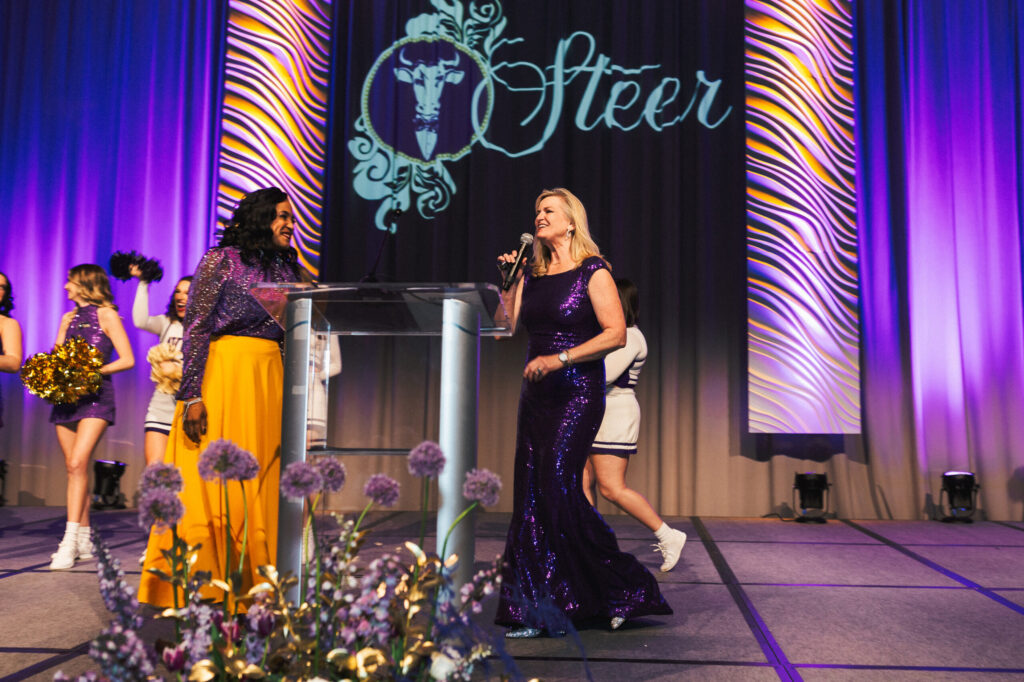
No gala is immune to surprises. Even the most carefully planned events face last-minute challenges. In this post, Shannon shares real-life gala scenarios and the planning decisions behind them, revealing how experienced auctioneers step in, take control, and protect both the donor experience and the fundraising outcome.
Real-world event challenges and the planning strategies that prevent them.
“Our auctioneer put a fire out…yes, a real fire!”
“What do you mean, no one recorded the fundraising results?”
“Why are the registration lines going all the way out the door?”
“But we’ve always done it this way.”
These are just a few of the phrases heard by meeting and event professionals across the country. If you’ve worked in events long enough, you can probably add a few of your own.
Planning a successful gala involves countless moving parts, and while professionals can recommend best practices, organizations sometimes choose to cut corners in an effort to save money. Unfortunately, those decisions often reveal their true cost on event night. Preparation is key, and when preparation falls short, the ability to clearly explain logistics, adapt in real time, and take control can make the difference between chaos and success.
The list of challenges (or as I’d like to say hair pullers) can be quite long. We all know, preparation is key. But as the professional auctioneer and consultant, you’re limited as to what you can do. Organizations too often say their budget won’t allow for the recommendations from the professionals. But sometimes, we must implement the art of negotiation.
Let’s take a look at a few real-world examples that show why preparation plus the ability to adapt matters so much on event night.
Scenario One: Cost-Cutting Bottlenecks
You recommended 6 bars for a crowd of 300 guests. The organization decided to save money and feels 2 will be sufficient. If allowed to happen, you shouldn’t be surprised on the night of the event when their lines are so long that they have to delay the start of the program to accommodate their guests.
In this instance, the conversation can be, “Here’s the reality, please understand that if you choose to have 2 bars with your 300 guests, this will mean approximately 150 guests per bar at an average time of 45 seconds each to prepare the drink and also ring it up (because it’s a cash bar). You’re looking at roughly 112 minutes, nearly two hours, to serve everyone. That’s not a theory; it’s math, and it won’t work!
When logistics are explained clearly and visually, decision-makers often understand the consequences of their choices more fully.
Scenario Two: Timeline Trouble
The timeline for the evening plays a critical role. You’ve planned a 30-minute window for serving the 1,000 guests. You’ve arranged your timeline to place this 30 minutes between the welcome and the program start. Then, four venue employees call in sick, adding 20 minutes to plate service.
Now, what do you do with these 20 minutes that have to be squeezed in? Do you…
- Just delay the program?
- Start while plates are dropping?
- Move something like the thank yous to sponsors to fill the time?
This is where flexibility is key to a smooth transition. If there’s already an option to add the sponsor thank-you’s to the welcome while plates are being dropped, you haven’t added 20 minutes to the evening; you’ve simply moved 20 minutes from after dinner to before.
The evening stays on track, and guests never feel the disruption. Problem solved.
Scenario Three: The Registration Lines
Few things sour donor experience faster than long registration lines.
The software company recommends six registration stations. The organization chooses four. With 500 planned attendees, that’s 125 guests in each registration line. At approximately 2 minutes per guest to register and capture their credit card information, each volunteer would need 4 hours to process their line. Again, it’s math, and it won’t work.
Even if guests arrive at staggered times, this is a logistical nightmare that puts donors in a bad mood before they even enter the event.
And sometimes, despite best planning, it’s too late. The event has started. Your contact is looking at you with panic in their eyes. What can you do to save the day?
Two options:
1) Have servers bring trayed wine and/or beer to attendees in line. Donors with a drink are far happier than donors without one.
2) If servers aren’t available, set out pre-poured champagne, wine, or even tubs of iced beer (depending on the theme) that guests can help themselves to.
Small, thoughtful adjustments can dramatically shift the mood and buy time while issues are resolved.
The Parts You Can’t Rehearse
These are all REAL scenarios that auctioneers have faced and how they reacted.
“Hey, the centerpiece is on fire!!!!” – The auctioneer jumped off the stage, threw water, put out the fire, got back on stage, and went back to work
“There’s a gentleman who’s had a medical issue. Is there a Dr. in the house?” The auctioneer commanded the room, created an aisle down the center of the room to get the stretcher and EMTs to the patient, and kept everyone calm until the patient was put into the ambulance. The team went right back to work and were respectful of the donor, who collapsed as well as his family. They thanked everyone in the room for their patience and grace.
You lose electricity, and the room is completely blacked out.– The auctioneer asked everyone in the room to turn on the flashlights on their phones and point them up. It generated enough light in the room to continue the fundraising. Numbers were incredibly high due to everyone’s compassion for the situation.
The Wi-Fi is down, and the donors can’t get on the app to give. The auctioneer goes old school with paper and pens for the silent auction and doesn’t miss a beat. The live auction and Fund-A-Need continue on with no hiccups, and all results are entered into the platform the next day.
In every case, the common thread is leadership. In each situation, the auctioneer took control and took action. When something unexpected happens, the auctioneer is the one holding the microphone, the voice the room naturally follows. That’s why it’s critical to have a trusted auctioneer who can roll with the punches, command the moment, and confidently guide the room forward.
Why This Matters
These situations were handled by professional benefit auctioneers who knew when to take control and how to adapt under pressure. But successful events rely on collaboration — between the venue, event planner, staff, and fundraising professionals.
Hurdles will happen. The key is expecting them, preparing for them, and working with experienced partners who know how to respond when things don’t go according to plan.
Because when donors feel confident, calm, and cared for, generosity follows.
If you’re questioning whether a professional auctioneer is right for your event, or if you’re ready to explore new auctioneer options, Everything Gala can help. Everything Gala works with organizations of all sizes and budgets, offering professional auctioneers to match your goals and event needs. Let’s talk about your event vision and how thoughtful planning and experienced leadership can help you reach your fundraising goals.
written by…
Shannon Eason
CEO of Everything Gala &
International Auctioneer Champion
Shannon Eason, Founder and CEO of Everything Gala, is a dynamic and engaging force in the world of fundraising. As an International Auctioneer Champion, she’s mastered the art of captivating audiences—blending charisma, energy, and strategy to inspire generosity and help organizations crush their fundraising goals. A recognized expert in the field, Shannon has presented at workshops, seminars, and conferences from coast to coast, sharing her insights and passion for elevating fundraising events. Through Everything Gala, she partners with nonprofits, schools, and socially driven causes to turn purpose into powerful results.


Copyright © 2025 Everything Gala